
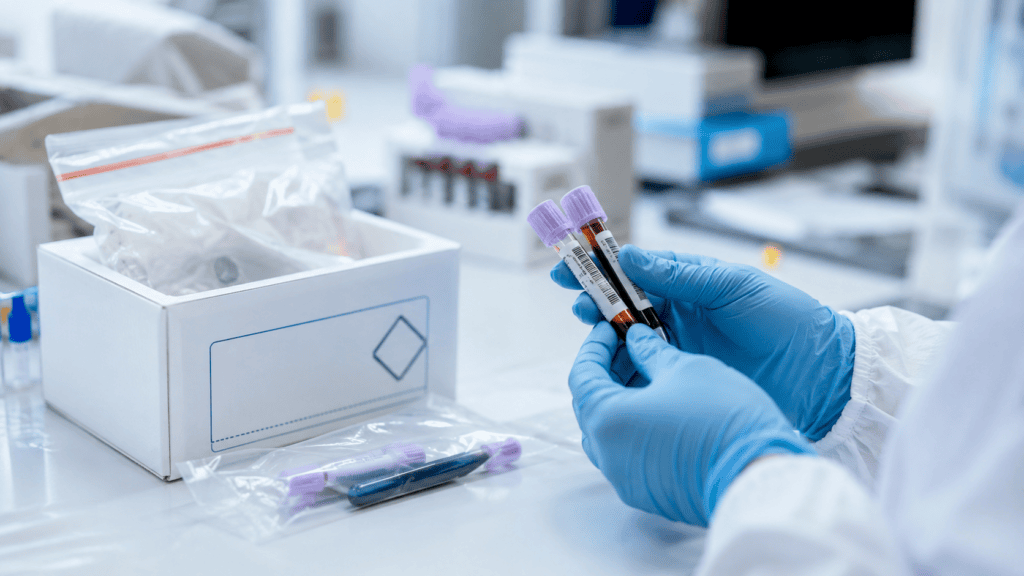
UN3373 is the United Nations number assigned to Category B biological substances – the classification that covers the vast majority of biological samples transported by laboratories, NHS trusts, universities and clinical research organisations across the UK. Getting the packaging right is not optional. Under the Carriage of Dangerous Goods and Use of Transportable Pressure Equipment Regulations 2009 (CDG Regulations), the sender is legally responsible for correct classification, packaging and labelling before any biological sample is handed to a courier for transport. This guide explains exactly what UN3373 packaging requires, what the P650 packing instruction means in practice, how to label your outer packaging correctly, and when you need a specialist medical courier rather than a standard parcel service.
What is UN3373?
UN3373 is the UN number for Biological Substance, Category B – infectious substances that do not meet the criteria for Category A classification. In plain terms, these are biological materials that are being transported for diagnostic or investigational purposes and are not known or reasonably expected to cause serious disease in healthy humans or animals under normal circumstances.
Category B (UN3373) covers the vast majority of biological samples transported in UK clinical and research settings, including:
- Blood, serum and plasma samples
- Urine, stool and swab specimens
- Tissue and biopsy samples
- Bone marrow samples
- Cerebrospinal fluid
- DNA and RNA preparations
- Microbiological cultures (non-Category A)
- Dried blood spots and filter paper samples
- Histology slides and fixed specimens
If a substance is known or reasonably expected to cause serious or potentially fatal disease in otherwise healthy humans or animals, it is Category A – assigned UN2814 (human pathogens) or UN2900 (animal pathogens) — and requires significantly more stringent transport arrangements including ADR driver certification and UN-approved packaging.
Category A vs Category B – What is the Difference?
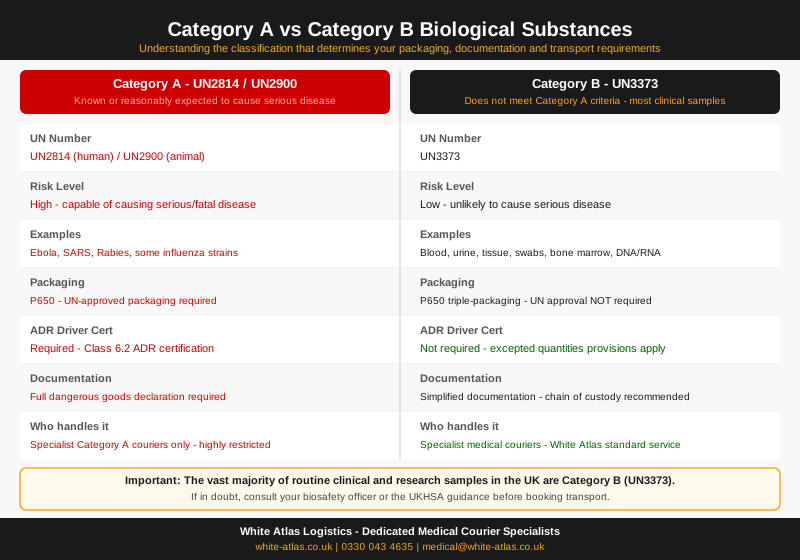
The classification of your biological substance determines everything: the packaging you must use, the documentation required, whether your courier needs ADR driver certification, and the legal obligations that apply to you as the sender. If you are unsure of your sample’s classification, consult your biosafety officer or refer to the UK Health Security Agency (UKHSA) guidance on the transport of infectious substances before booking any courier service.
What is the P650 Packing Instruction?
P650 is the packing instruction that applies to UN3373 Category B biological substances. It specifies the triple-packaging system that must be used when transporting biological samples by road (under ADR) and by air (under IATA Dangerous Goods Regulations). The same triple-packaging principle applies to both modes, with some additional performance test requirements for air transport.
The P650 packing instruction requires three distinct layers of packaging, each serving a specific function in maintaining the integrity and containment of the biological substance throughout transport.
The UN3373 Triple-Packaging System
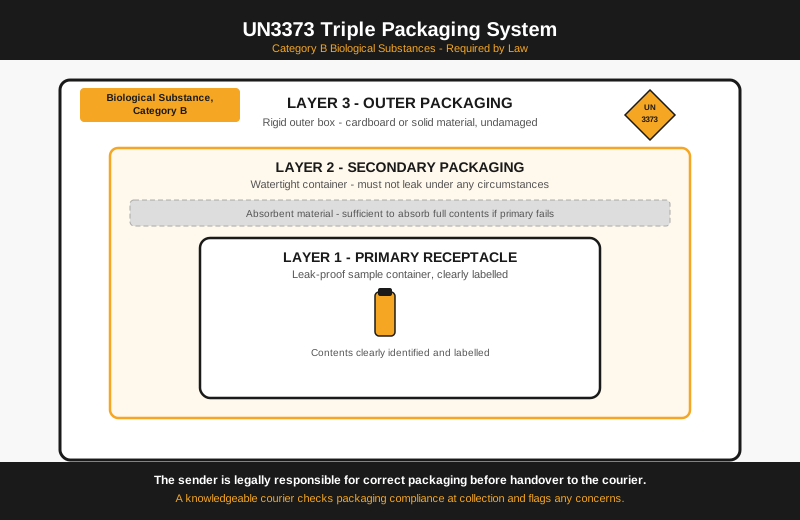
Layer 1 – The Primary Receptacle
The primary receptacle is the container that directly holds the biological substance. It must be leak-proof and clearly labelled with the contents. For liquid specimens, the primary receptacle must be capable of withstanding internal pressure without leaking. Common examples include sample tubes, specimen jars and blood collection tubes.
Layer 2 – The Secondary Packaging
The secondary packaging is a watertight container that encloses the primary receptacle. If the primary receptacle leaks or breaks during transport, the secondary packaging must contain the spill entirely. Absorbent material – sufficient to absorb the entire liquid contents of the primary receptacle if it fails – must be placed between the primary receptacle and the secondary packaging. Multiple primary receptacles may be placed in a single secondary packaging provided they are individually wrapped and sufficient absorbent material is present.
Layer 3 – The Outer Packaging
The outer packaging is the rigid external container that protects the secondary packaging during transport. It must be strong enough to withstand the stresses of normal transport conditions. The outer packaging must have at least one surface with a minimum dimension of 100mm x 100mm – this is where the UN3373 mark, the proper shipping name and the sender and recipient details are applied. Unlike Category A substances, UN3373 outer packaging does not need to be UN-approved, but it must demonstrate that it can pass certain performance tests appropriate to its construction.
UN3373 Labelling Requirements – Exact Specifications
Correct labelling of the outer packaging is a legal requirement. The following must appear on the outside of every UN3373 consignment:

The UN3373 Diamond Mark – Exact Dimensions
The UN3373 mark is a square set at an angle of 45 degrees – a diamond shape. The exact dimensions required are:
- Each side of the diamond must be at least 50mm in length
- The width of the border lines must be at least 2mm
- The letters “UN3373” inside the diamond must be at least 6mm in height
- The outer packaging must have at least one surface measuring a minimum of 100mm x 100mm
The proper shipping name “Biological Substance, Category B” must appear in full adjacent to or below the diamond mark. The sender’s name and address and the recipient’s name and address must also appear on the outer packaging. For air transport, a responsible person’s name and telephone number must also be included.
Quantity Limits Under P650
P650 specifies maximum quantities for UN3373 consignments:
- The primary receptacle must not contain more than 1 litre of liquid
- The total contents of the outer packaging must not exceed 4 kilograms
- These quantity limits exclude ice, dry ice or liquid nitrogen used for temperature maintenance – the weight of refrigerant does not count toward the 4kg limit
For consignments containing multiple primary receptacles within a single outer packaging, the combined total of all primary receptacles must not exceed the 4kg outer packaging limit.
Road vs Air – Key Differences for UN3373 Transport
The core triple-packaging requirement is the same for both road and air transport of UN3373 biological substances. However, air transport under IATA regulations imposes some additional performance requirements that do not explicitly apply to road transport under ADR.
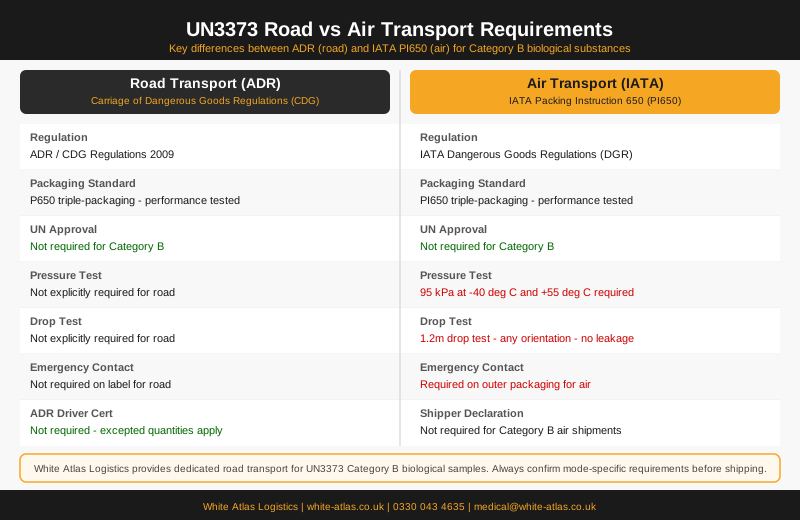
For dedicated road transport of UN3373 Category B biological substances – which is the most common transport method for UK clinical and research samples – the key practical points are:
- ADR driver certification is not required. Category B substances fall within the excepted quantities provisions of ADR, meaning specialist ADR-licensed vehicles and driver ADR certificates are not mandatory for UN3373 alone. However, the courier must be informed of the nature of the consignment.
- Correct packaging, labelling and documentation remain legally required regardless of the ADR exemption.
- A chain of custody record – though not explicitly mandated by ADR for Category B – is strongly recommended for clinical and research samples and is standard practice for specialist medical couriers.
Who is Responsible for UN3373 Packaging?
This is one of the most frequently misunderstood aspects of biological sample transport. Under the CDG Regulations, the sender – the laboratory, clinic, hospital or research organisation dispatching the sample – is legally responsible for:
- Correctly classifying the biological substance (Category A or Category B)
- Packaging the sample in accordance with P650 requirements
- Applying the correct UN3373 labelling to the outer packaging
- Providing appropriate documentation
The courier’s legal responsibility begins once the correctly packaged and labelled consignment is handed over. A competent medical courier will check packaging compliance at collection and will not accept a consignment that is incorrectly packaged or labelled – doing so creates liability risk for both parties.
University laboratories, NHS pathology departments and clinical research organisations working with multiple hospital collection sites across the UK typically have internal packaging protocols and trained staff responsible for sample preparation. For organisations new to biological sample transport, or those reviewing their packaging procedures, the UKHSA guidance on the transport of infectious substances and the relevant ADR chapter on Class 6.2 are the primary reference documents.
Does a Courier Need Special Certification to Transport UN3373 Samples?
For Category B (UN3373) biological substances transported by road in the UK, specialist ADR driver certification is not a legal requirement. The excepted quantities provisions of ADR mean that neither the vehicle nor the driver requires ADR licensing solely for UN3373 consignments.
However, not every courier is suitable for biological sample transport – and the absence of an ADR requirement does not mean any courier will do. What matters is whether the courier:
- Understands UN3373 classification and the nature of the consignment
- Checks packaging compliance before collection
- Operates a dedicated vehicle – no shared loads, no depot handling
- Provides a full chain of custody record from collection to delivery
- Has procedures in place for spill and incident response
- Can maintain appropriate temperature conditions where required
- Is available 24/7 including weekends and bank holidays
University laboratories, NHS pathology departments, biobanks and clinical research organisations working with time-sensitive biological samples require a courier that genuinely understands the clinical and compliance environment – not a general parcel service that happens to accept sample tubes.
White Atlas Logistics provides dedicated same-day transport for UN3373 Category B biological samples for research organisations, university laboratories and healthcare providers across the UK. Every consignment travels on a dedicated vehicle with no shared loads, full chain of custody documentation and direct contact with our operations team throughout the journey. For further information on our biological sample courier services or our broader healthcare and medical logistics capabilities, please visit the relevant pages or contact us directly.
Common UN3373 Packaging Mistakes
1. Using a non-watertight secondary container
The secondary packaging must be genuinely watertight – not simply a ziplock bag or an unsealed container. If the primary receptacle leaks and the secondary packaging fails to contain the spill, the outer packaging and its contents become contaminated and the consignment is non-compliant.
2. Insufficient absorbent material
The absorbent material between the primary receptacle and the secondary packaging must be sufficient to absorb the entire liquid contents of the primary receptacle. A single layer of paper towel is rarely sufficient. Proper absorbent pads or materials should be used.
3. Incorrect or missing UN3373 mark
The diamond mark must meet the minimum dimension requirements – 50mm per side, 2mm border lines, 6mm text height. A printed label that is too small, or a hand-drawn mark that does not meet the dimensional requirements, does not satisfy the labelling obligation. Pre-printed compliant UN3373 labels are available from specialist packaging suppliers.
4. Missing proper shipping name
“Biological Substance, Category B” must appear on the outer packaging in full. Abbreviations or partial descriptions do not satisfy the requirement.
5. Exceeding quantity limits
Sending more than 1 litre in a single primary receptacle, or more than 4 kilograms total in an outer package, exceeds P650 quantity limits. Where larger quantities must be transported, multiple compliant packages should be used.
6. Assuming the courier will check everything
The legal responsibility for correct packaging sits with the sender – not the courier. A specialist medical courier will check compliance at collection and may refuse to accept a non-compliant consignment, but the obligation to package correctly in the first place rests with the laboratory or healthcare organisation dispatching the sample.
UN3373 Packaging for Clinical Trial Samples
Clinical research organisations and university laboratories running multi-site clinical trials face a particular packaging challenge – biological samples must be collected from multiple hospital and clinical sites across the UK and transported reliably to a central laboratory for analysis. In this context, consistent UN3373 packaging compliance across all collection sites is essential.
For trials collecting bone marrow, blood or tissue samples from patients at multiple NHS sites – including from Freeman Hospital in Newcastle, the Christie in Manchester, St James’s in Leeds or specialist oncology centres across the UK – the P650 triple-packaging requirement applies at every collection point regardless of the distance to the receiving laboratory.
White Atlas Logistics supports clinical research organisations and university laboratories with scheduled and ad-hoc clinical trial courier services across the UK, including same-day collections from NHS hospital sites with full chain of custody documentation. Our operations team works directly with laboratory managers and trial coordinators to ensure every movement meets the documentation and handling requirements of the trial protocol.
Dry Ice and Temperature-Controlled UN3373 Transport
Many UN3373 biological samples – particularly those used in genetic research, biobanking or RNA analysis – require transport at controlled temperatures, including with dry ice or liquid nitrogen. Temperature requirements do not change the UN3373 classification or P650 packaging obligation, but they introduce additional practical and safety considerations.
Dry ice (solid carbon dioxide) sublimates during transport, releasing CO2 gas. In an enclosed vehicle, this can create a hazard if ventilation is inadequate. Any vehicle used to transport UN3373 samples packed in dry ice must be properly ventilated. Biological samples should not be placed in direct contact with dry ice as the extreme temperature (-78.5°C) can damage sample integrity.
For UN3373 samples requiring ambient temperature, refrigerated (2-8°C) or frozen transport, always confirm the exact temperature requirement with your receiving laboratory before booking. Many routine clinical diagnostic samples – including blood for general testing, tissue biopsies in formalin and bone marrow aspirates – travel at ambient temperature, often with ice packs supplied by the sending laboratory. Your laboratory courier should confirm vehicle suitability and temperature capability at the time of booking.
Official Guidance and Further Reading
The following official sources provide authoritative guidance on UN3373 packaging requirements and the transport of biological substances in the UK and internationally:
- Carriage of Dangerous Goods Technical Guidance (CDG Regulations 2009) – GOV.UK / Department for Transport
- Guidance on the transport of infectious substances – UK Health Security Agency (UKHSA)
- IATA Dangerous Goods Regulations – Packing Instruction 650 (current edition)
- Guidance on Regulations for the Transport of Infectious Substances – WHO
- Dangerous Goods Transport Guidance – Health and Safety Executive (HSE)
All links open in a new tab. Regulations are updated periodically – always confirm you are referencing the current edition before shipping.
Free Resource: Biological Sample Transport Compliance Checklist
A printable pre-collection checklist covering UN3373 compliance, packaging verification, chain of custody initiation and proof of delivery requirements – used by laboratories, healthcare providers and clinical research organisations across the UK.
To receive your free copy, email us at medical@white-atlas.co.uk and we will send it straight to you – no sign-up required.
How White Atlas Logistics Supports UN3373 Biological Sample Transport
White Atlas Logistics provides dedicated same-day transport for UN3373 Category B biological samples for university laboratories, NHS pathology departments, clinical research organisations and private healthcare providers across the UK.
Every biological sample consignment travels on a dedicated vehicle – no shared loads, no depot handling, no unnecessary touchpoints. We provide full chain of custody documentation from collection to delivery, time-stamped proof of delivery with recipient name and signature, and direct contact with our operations team throughout every movement. Our drivers are briefed on the nature of every medical consignment before collection and follow documented incident and spill response procedures.
We support both scheduled regular collections – including multi-site clinical trial sample movements from NHS hospital sites across the UK – and urgent same-day collections at short notice, 24 hours a day, 7 days a week including weekends and bank holidays.
For more information visit our biological sample courier service page, our laboratory courier page or our clinical trial logistics page. To discuss your specific requirements contact us directly on 0330 043 4635 or email medical@white-atlas.co.uk.
Frequently Asked Questions
What does UN3373 stand for?
UN3373 is the United Nations identification number for Biological Substance, Category B – infectious substances transported for diagnostic or investigational purposes that are not expected to cause serious disease in healthy humans or animals. It is the classification that applies to the vast majority of routine clinical and research biological samples transported in the UK.
Is UN3373 packaging the same as P650 packaging?
P650 is the packing instruction that applies to UN3373 substances. The terms are often used interchangeably. P650 specifies the triple-packaging system – primary receptacle, secondary watertight packaging with absorbent material, and rigid outer packaging – that must be used when transporting UN3373 biological substances by road or air.
Does UN3373 packaging need to be UN-approved?
No. Unlike Category A substances, UN3373 Category B packaging does not need to be UN-approved. However, the packaging must demonstrate that it can pass certain performance tests appropriate to its construction. Pre-tested compliant packaging solutions are available from specialist laboratory packaging suppliers.
Can I send UN3373 samples by Royal Mail?
Royal Mail does accept certain Category B biological substances (UN3373) under its Biological Substances service, subject to the samples being correctly packaged to P650 requirements, not exceeding quantity limits, and meeting Royal Mail’s specific acceptance criteria. Royal Mail’s service is not suitable for urgent, time-critical or temperature-sensitive samples. For any consignment where reliability, speed, temperature control or chain of custody is important, a dedicated specialist medical courier is strongly recommended.
What is the quantity limit for UN3373 packages?
Under P650, the primary receptacle must not contain more than 1 litre of liquid. The total contents of the outer packaging must not exceed 4 kilograms. These limits exclude the weight of ice, dry ice or liquid nitrogen used for temperature maintenance.
Does a courier need ADR certification to transport UN3373 samples?
For Category B (UN3373) biological substances transported by road, ADR driver certification is not a legal requirement. Category B substances fall within the excepted quantities provisions of ADR, meaning specialist ADR-licensed vehicles and driver certificates are not mandatory. However, correct packaging, labelling and documentation are legally required, and the courier must be informed of the nature of the consignment. A specialist medical courier – rather than a general parcel carrier – is strongly recommended for any biological sample transport.
Who is responsible for UN3373 packaging – the sender or the courier?
The sender is legally responsible for correct classification, packaging and labelling before the consignment is handed to the courier. The courier is responsible for transporting the correctly packaged consignment appropriately and maintaining chain of custody. A specialist medical courier will check packaging compliance at collection and may refuse a non-compliant consignment, but the obligation to package correctly rests with the laboratory or healthcare organisation dispatching the sample.
What is the difference between UN3373 and UN2814?
UN3373 covers Category B biological substances unlikely to cause serious disease, transported for diagnostic or investigational purposes. UN2814 covers Category A substances – those known or reasonably expected to cause serious or potentially fatal disease in healthy humans. Category A transport requires full ADR compliance including driver certification, UN-approved packaging and detailed documentation. The vast majority of routine clinical and research biological samples in the UK are Category B (UN3373).
Related reading: Which Couriers Can Deliver Biological Samples in the UK? – our complete guide to choosing the right courier for biological sample transport, covering regulations, temperature requirements and what to look for in a medical courier.

One Response